
5 min read
This article is part of the Hello Future series, which equips employers with the knowledge and resources they need to put workforce transformation into action.
Ask the boss of any small and medium enterprise (SME), and they will tell you that their top concern is the bottom line. For them, if something does not boost revenue, it is probably not worth pursuing.
Among these is “workforce transformation” — an umbrella term that encompasses everything from redesigning jobs to upskilling or reskilling workers. For time-starved SME leaders, workforce transformation may seem like a good-to-have, not a must-have. But one expert has a different perspective.
“With the way work is going today, SMEs are going to be constantly faced with disruptions of many different types,” said Associate Professor Renee Tan, Assistant Executive Director at the Institute for Adult Learning (IAL), an autonomous institute within the Singapore University of Social Sciences.
“Disruption that you can control (workforce transformation) is better than external disruption that you have little to no power over,” she added.
With artificial intelligence and geopolitical uncertainty throwing business playbooks out the window, companies are changing how they work. But these new business strategies should be complemented by workforce transformation strategies for their employees.
Unfortunately, not many SMEs in Singapore understand how to combine their business strategies with people strategies. According to an IAL study, only about 10 per cent of SMEs do so.
“And when they do it successfully, it’s such a winner. These are the best-performing SMEs in Singapore,” said Assoc Prof Tan, who is also Director of IAL’s Research Division.
Here are five pitfalls that SME leaders stumble into when they think about workforce transformation.
Pitfall #1: Workforce transformation is only relevant for big multinational corporations (MNCs).
The common sentiment is that only MNCs, which have sufficient wiggle room to experiment, should embark on workforce transformation.
But transformation is even more pertinent for SMEs. “Big MNCs are cushioned by a large workforce with a combined skill pool and power that is much greater than SMEs. For SMEs, it's even more important that they look to their workforce to mine whatever potential they have there,” explained Assoc Prof Tan.
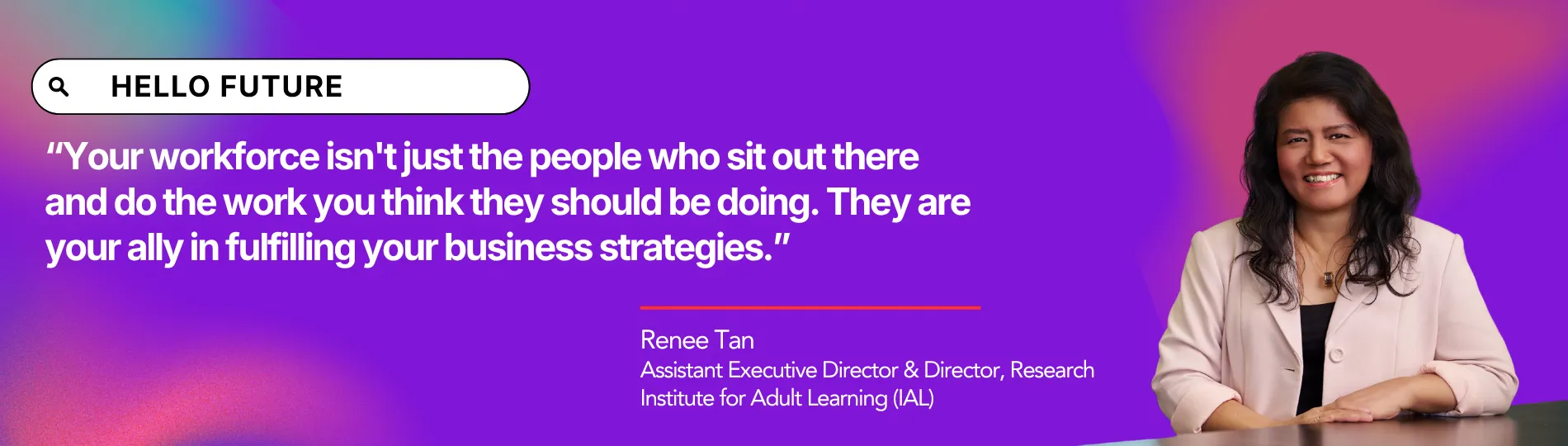
“Your workforce isn't just the people who sit out there and do the work that you think they should be doing. They are your ally in fulfilling your business strategies,” she added.
Pitfall #2: Workforce transformation is expensive and time-consuming.
The costs of workforce transformation need not be borne by companies alone.
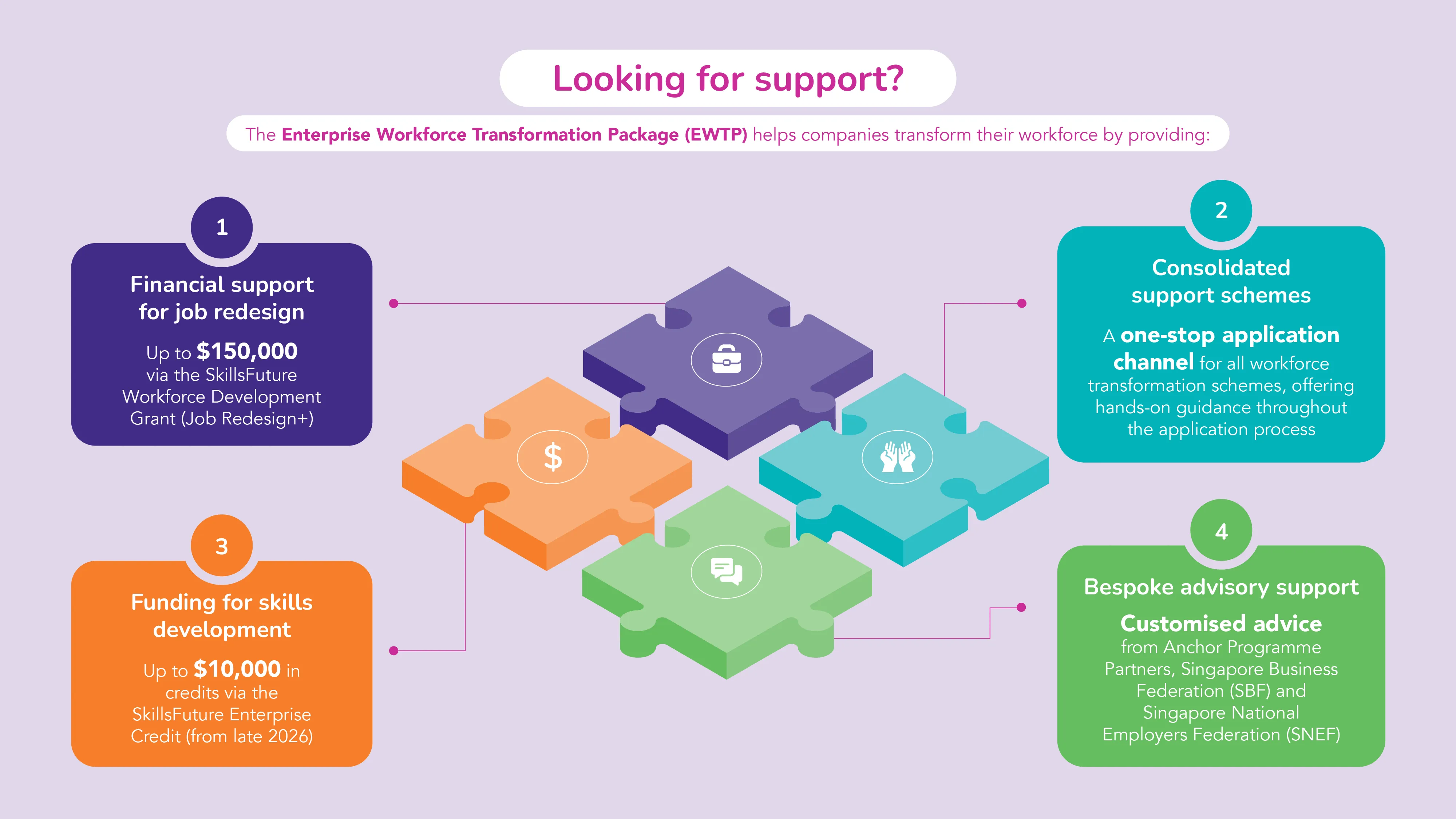
The government has set aside over $400 million to support companies through the Enterprise Workforce Transformation Package (EWTP), which also provides advisory support.
“It's all there –– so what SMEs need is clarity about what outcome they want to achieve,” said Assoc Prof Tan. “Then it's a matter of engaging the right packages and putting them together.”
Pitfall #3: If I send my employees for reskilling or upskilling, they might leave after training.
Employees are more likely to stay when training is properly mapped to job responsibilities.
“If workers actually benefit from learning…and see how reskilling and upskilling contribute to value creation, I think they will find that they have skin in the game,” said Assoc Prof Tan.
Many employers worry about losing trained employees to competitors. However, Assoc Prof Tan believes SMEs have more to gain from collaboration within the ecosystem, rather than competition.
In this regard, Singapore can afford to learn from countries like Australia, she noted. Rather than shy away from training workers for fear that they will leave, Australian companies see training as a tool that benefits the wider industry, beyond individual workers.
“They believe that somewhere else in the industry, other companies are also training their next workers,” she explained. In this way, companies help each other –– and themselves –– move up the value chain.
Pitfall #4: Employees are change-averse, and changing their job roles may cause them to leave.
Workforce transformation, like any type of change management, is not easy.
But once employers are convinced that it makes business sense, there is only one path ahead: Convince employees to take the journey of change together, by outlining the big picture and highlighting the value it will bring to them.
For those finding it tough to have that conversation, there are resources like the Career Conversations Guidebook to help leaders clearly communicate potential career pathways to employees.
According to Assoc Prof Tan, employers should share their plans with employees early, and be open to feedback.
“If they grew alongside that plan, and actually contributed to that plan and its fulfilment…it might help to mitigate resistance,” she said.
Pitfall #5: Workforce transformation is a one-time project.
Workforce transformation does not happen overnight. “There’s no guarantee that along the way, there won’t be a need to change and push the target even further because of the speed of disruption,” highlighted Assoc Prof Tan.
The key to succeeding is viewing business and people strategies as inseparable. “Workforce transformation doesn't mean that you just change the workforce for its own sake. You're changing the workforce because you want your business to succeed,” she said.
While successful transformation might look different for every business, the most important indicator is that it is a “win-win for all”.
“When you have reached that point where your workforce is uplifted alongside you, you've done something that has led to a change, and it's giving you more benefits –– that would be success,” she said.
Ready to begin? Find the right programme for your needs here.
For more articles from Hello Future, click here.