
This article is part of the Hello Future series, which equips employers with the knowledge and resources they need to put workforce transformation into action.
Enter Lim Kee Food Manufacturing’s factory in Woodlands, and you will be hit with an array of tantalising scents: fluffy steamed buns, sweet red bean paste, and braised meat. Workers gather around assembly lines, efficiently operating machines that pack buns 20 at a time, before they are carted off to supermarkets and coffee shops or sold online.
This is the Lim Kee of today. But six years ago, during the COVID-19 pandemic, the homegrown steamed bun manufacturer nearly found itself on the menu. Suddenly, the firm’s production team — largely comprising foreigners — couldn’t work because of dormitory lockdowns. Customers could no longer dine out, and sales dried up for Lim Kee’s traditional trade.
“COVID was the biggest wake-up call for Lim Kee,” said Ms Ang Shu Min, the firm’s Head of Business Services. “Pre-COVID, we focused a lot on business operations. How many baos could we produce everyday? But during COVID, our coffee shop sales totally shrank, and we had to find other channels.”
It sparked new urgency in the company’s transformation plans. With business-as-usual no longer possible, Lim Kee had to pivot to a different model. They began distributing their products on online e-commerce platforms, selling directly to customers on top of their usual Business-to-Business (B2B) operations.
This strategy had to be accompanied by workforce transformation, spearheaded by the human resources (HR) department. “When the pandemic occurred, the management saw how essential it was for HR to be part of management, to do better planning, recruitment, and training,” said Ms Ang.
From Operations to Strategy
Lim Kee’s workforce transformation journey began with Ms Ang. For years, she operated as a one-person HR department. “I was really tied up… The majority of the time, I was doing data entry work,” she said.
It was an operations-based role, but she needed to turn it into a strategy-based one. This would allow her to focus on attracting local talent to shore up succession plans, making the business more resilient to future disruptions.
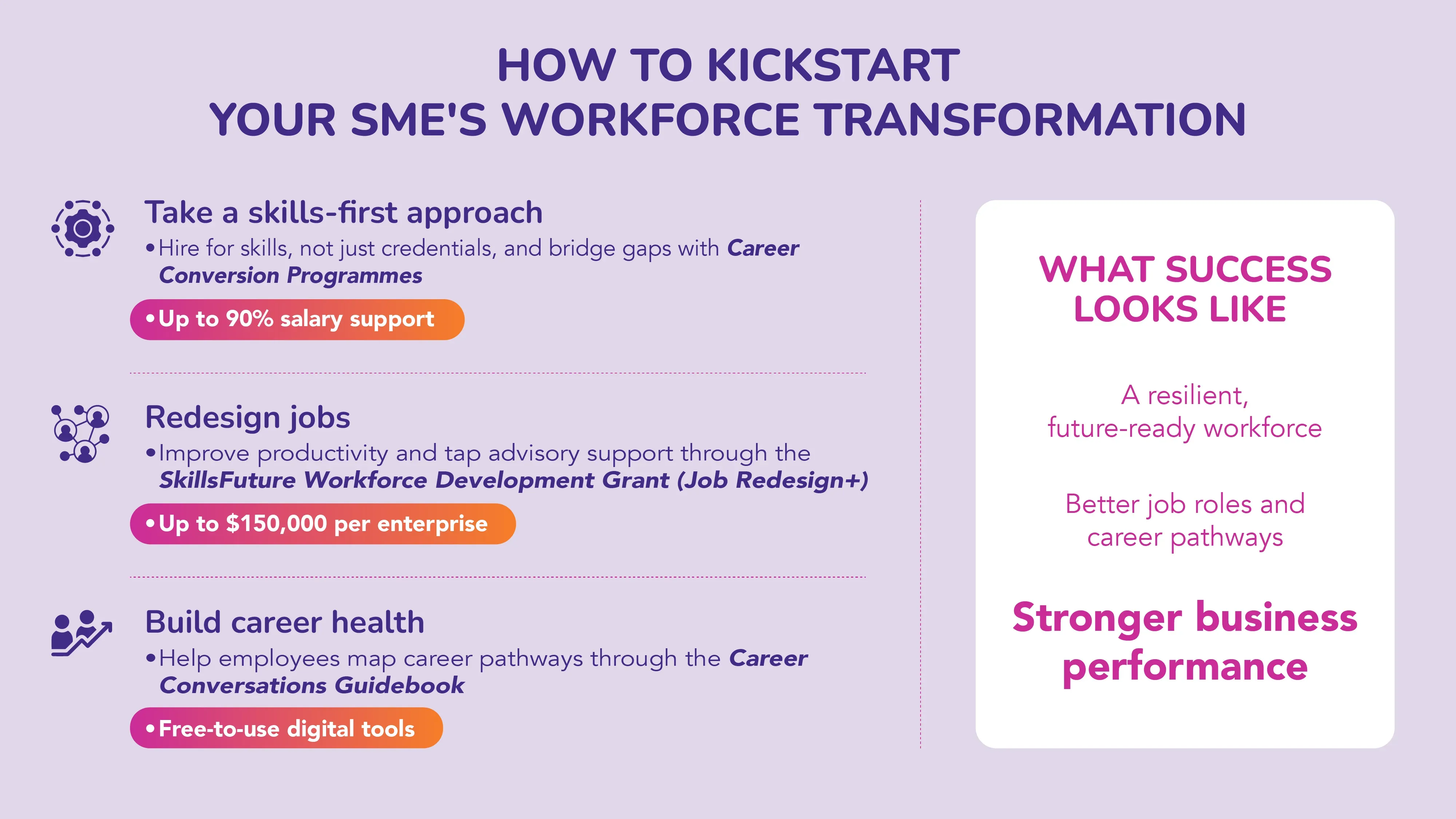
One of the first things she did was speak with a consultant from the Institute for Adult Learning about her pain points. The workplace learning consultant helped her sketch out practical solutions, including building up standards in customer service.
At the time, employees were not confident in speaking to customers or even among themselves. “They would say, ‘Go to Shu Min.’ I was like a doctor, trying to solve everyone’s problems,” said Ms Ang. But the consultant, whom she ended up working with for about six years, helped her train others to take on more customer-facing roles and build up people managers.
This gave her the space she needed to revamp the human resource portfolio within Lim Kee and upgrade herself with the WSQ Advanced Certificate in Learning and Performance (ACLP), offered by the Institute for Adult Learning. The ACLP prepares participants to design, deliver, and assess learning programmes for adults, especially in the context of workplace and industry transformation.
It helped her get a seat at the management table, where she was able to convince management to hire local talent through SkillsFuture Work-Study Programmes for different functions in Lim Kee, including HR, logistics, and food technology.
“Management wasn’t 100 per cent on board,” admitted Ms Ang. “The attitude was more like, ‘Okay, there’s no harm trying.’” But the move helped to reduce the operational load on existing staff, while also exposing more youth to the industry.
“There’s a stigma around food manufacturing, which is why we face a manpower crunch for our local workforce,” she noted. “The work-study programme is a nurturing platform for youngsters… to attract them to the industry. It is a form of succession planning for us.”
Leading by Example
While Ms Ang could have chosen to kick off Lim Kee’s workforce transformation journey in another department, she wanted to start with herself. “I knew that if I were to convince my management or employees to redesign jobs, HR needed to understand how to do the change,” she said.
Her experience allowed her to speak with authority when the time came to help others upskill. Line workers, who previously manually packed buns four at a time, had to learn how to operate packing machines instead.
Other employees became heads of department, a role that previously did not formally exist. It meant they were empowered to make certain decisions independently of the bosses.
Throughout the process, Ms Ang was aware of the need for proper change management.
“You need to lead by example and do it first, then communicate with them and convince them,” she said. “I didn’t use the word ‘job redesign’ as it's too atas (Malay for ‘posh’) for my people. Instead, I told them that we needed to unlearn and relearn.”
She added with a laugh: “Now, one auntie can handle the whole conveyor machine by herself.”
These days, Lim Kee focuses on people as much as they do on baos. Talent metrics, which include turnover rate, learning and development hours, and satisfaction scores, account for about 20 per cent of business metrics, shared Ms Ang.
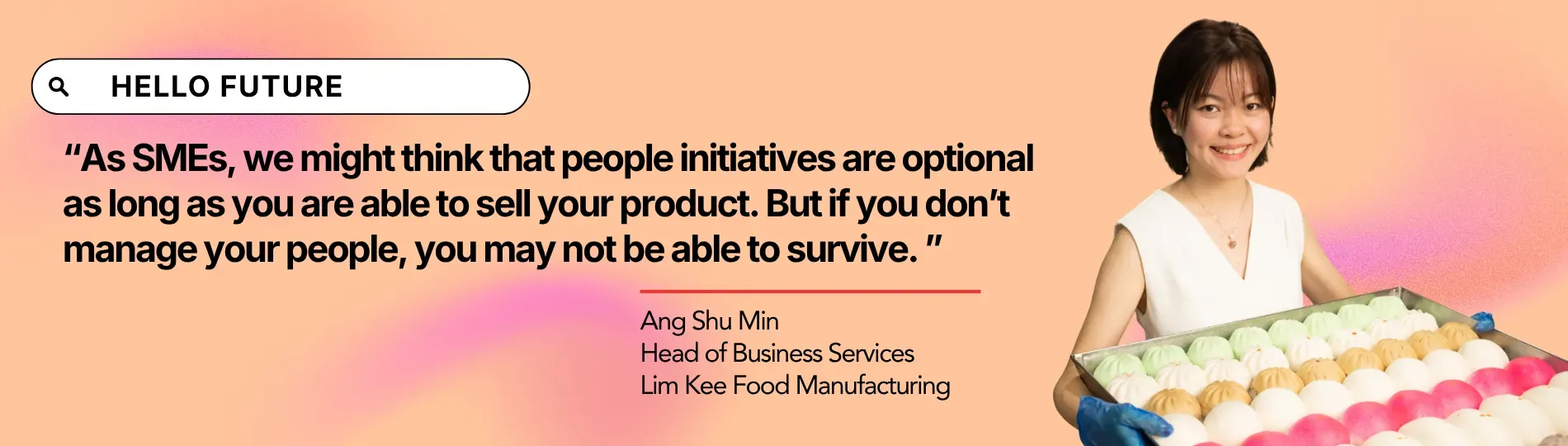
“As SMEs, we might think that people initiatives are optional as long as you are able to sell your product. But if you don’t manage your people, you may not be able to survive,” she said.
Ready to begin? Find the right programme for your needs here.
For more articles from Hello Future, click here