
This article is part of the Hello Future series, which equips employers with the knowledge and resources they need to put workforce transformation into action.
Multiple Excel spreadsheets, complex mathematical formulas, and a dizzying array of open tabs. This was the daily reality that human resource (HR) practitioners in a local small and medium-sized enterprise (SME) faced while managing the company’s payroll.
“They needed about three working days to match manpower to project costs. HR had to do a lot of back-and-forth calculations,” recounted Ms Nellie Yeoh, Director and Practice Leader (People Advisory) at BDO Singapore, who was advising this SME on how to integrate their HR and information technology capabilities.
This tedious process was eliminated when the company, which is in the built environment sector, began incorporating artificial intelligence (AI) into work processes. With the help of consultancy services provided by Ms Yeoh, the SME deployed agentic AI — a form of AI that is able to operate autonomously — to streamline workflows.
“That saved about 20 to 30 per cent of staff’s time, which meant that the HR role could be refocused into stakeholder engagement or people development,” she elaborated.
It was a successful example of AI-guided job redesign that not only brought tangible benefits to the business, but also helped employees climb the skills ladder.
Naturally, AI-enabled productivity gains may vary across businesses. But some core principles remain the same. To maximise impact, invest in AI across workflows and processes, not just at the level of specific job roles.
“Only then will you be able to affect several roles, instead of just one,” she said.
Why Redesign Work, and Why AI?
Job redesign, which involves strategically examining how to make tasks, functions, and processes more efficient, helps SMEs perform well in Singapore’s hyper-competitive business environment.
But AI has given it new urgency. As routine cognitive tasks are automated, businesses must adapt to keep job roles relevant. Not doing so could mean becoming more expensive and eventually, losing out to competitors, said Ms Yeoh.
Still, it takes a solid digitalisation strategy to meaningfully embed AI in job roles.
Organisations need to consider factors like data security, data governance, and digital infrastructure, while also keeping their organisational goals front and centre.
“You don’t redesign a role for the sake of it,” said Ms Yeoh, adding that leaders must be clear about their priorities and growth areas they want to focus on.
How to do Job Redesign
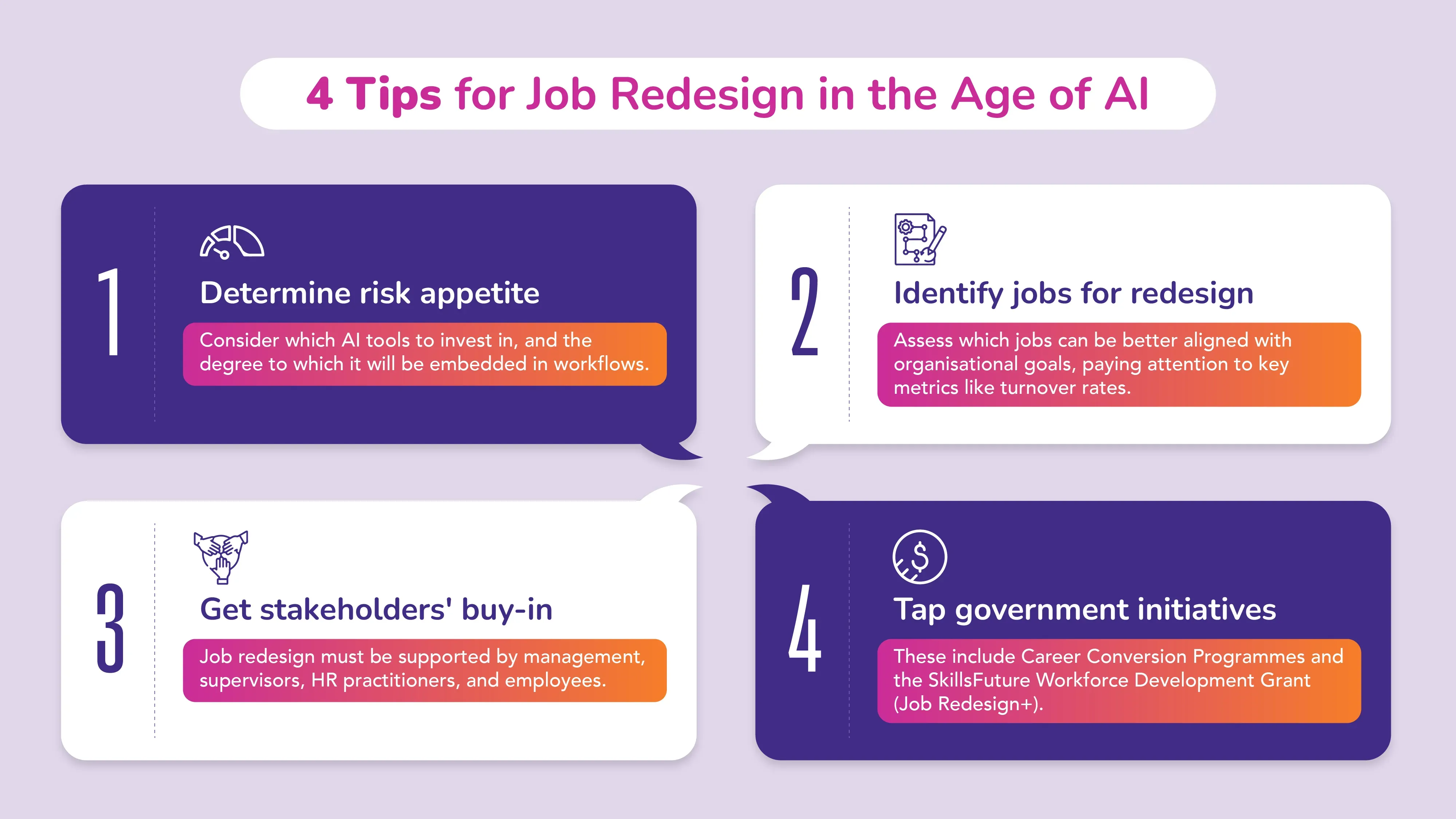
Once business leaders have established clear AI policies and priority growth areas, they may be wondering how to begin redesigning jobs. Ms Yeoh offers four useful tips for leaders embarking on this journey.
Tip 1: Determine risk appetite. Most SMEs tend to use AI in a piecemeal way, said Ms Yeoh. One common scenario is sharing a single premium subscription to an AI chatbot across teams and departments.
“Data becomes less customised, and a lot of client information cannot be shared. Employees have to anonymise the data they put in or rewrite prompts,” she said, adding that this hinders effectiveness.
For companies willing to take the leap, agentic AI may be a solution. This is an internal AI chatbot capable of handling proprietary information, which will help staff spend time on more meaningful tasks.
Tip 2: Identify which jobs to redesign. This depends on organisational goals, said Ms Yeoh. For instance, if a company wants to prioritise efficiency, they should assess which jobs have the most overhead costs. Concrete data points, such as revenue trends and productivity key performance indicators (KPIs), send important signals.
Other roles that are ripe for redesign are those that have high turnover rates, fall short of industry benchmarks, or can easily be made more efficient with technology, she explained. That said, she emphasised that redesigned jobs should retain a “human touch” — the element of connection and human-to-human interaction that technology may not be able to replicate.
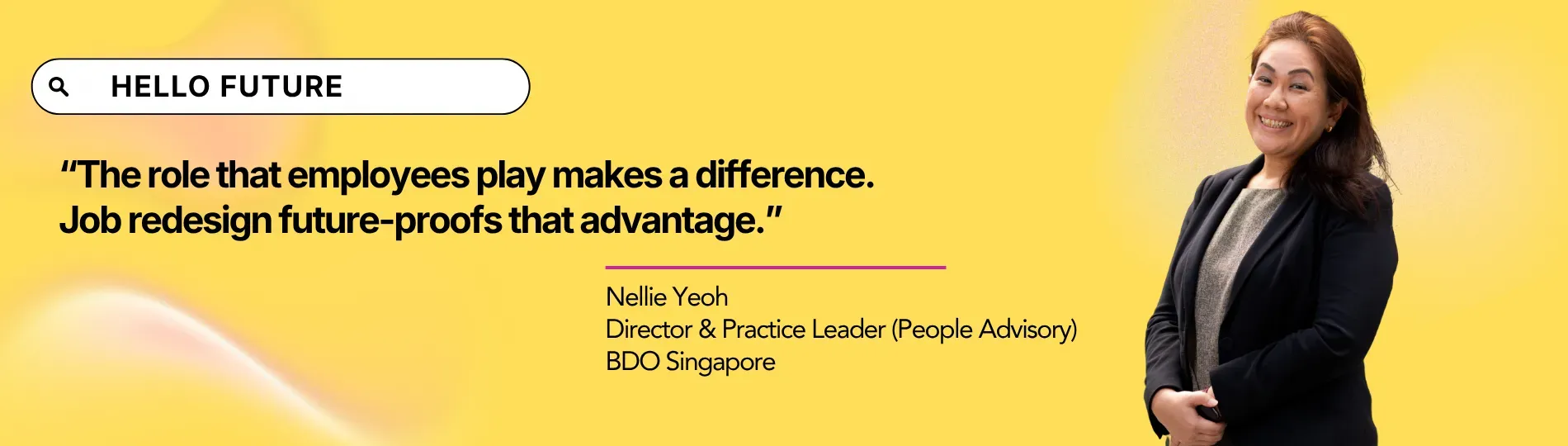
“The role that employees play makes a difference,” she said. “(Job redesign) future-proofs that advantage.”
Tip 3: Get the buy-in of key stakeholders. People may have strong assumptions about what makes a role work, but these assumptions should be challenged, because even roles that work well can be improved, she said.
Management, supervisors, HR practitioners, and employees themselves must support the job redesign process for it to truly be effective and lasting.
Each plays a different role. “Management should be committed to providing the resources for job redesign, while HR must have the capability and capacity to facilitate the process. Job holders and supervisors must feel reassured and supported, for example, through training,” noted Ms Yeoh.
Tip 4: Tap on available government support. There is a whole spectrum of resources out there, including Career Conversion Programmes and the Workforce Development Grant (Job Redesign+), which not only provide support, but also help to keep an organisation accountable to its goals.
The litmus test? Ask yourself if the redesigned job role can be sustained for at least two to three years. HR can help this process through simple steps like updating job descriptions, educating employees on how their KPIs will change, and reviewing training plans. “HR must formalise change and ensure that there is continuity,” she added.
Undeniably, job redesign can be a disruptive process. “It is like ‘unboxing the box’. It means jeopardising business-as-usual. There’s always a risk,” cautioned Ms Yeoh.
But employers need to press on to see the results, she said, adding, “That means being committed to the outcome and the resources that need to be invested in order to achieve it.”
Ready to begin? Find the right programme for your needs here.
For more articles from Hello Future, click here