
3 min read | Manufacturing
Introduction
Keystone Cable is a Singapore-based small-and-medium sized enterprise (SME) specialising in cable manufacturing for a range of industries. Over its 35-year history, the company has faced a recurring challenge common to many SMEs: scaling operations and implementing new technologies to stay competitive while managing headcount constraints.
Highlights of Keystone Cable’s Workforce Transformation
- Reskilled employees with no manufacturing experience through the Career Conversion Programme (CCP) for Advanced Manufacturing Engineer/Assistant Engineer
- Digitised labour-intensive Human Resources workflows through the HR Job Redesign Initiative
- Implemented a real-time production tracking app, enabling digital tracking and analysis of manufacturing operations
Introduction
Keystone Cable is a Singapore-based small-and-medium sized enterprise (SME) specialising in cable manufacturing for a range of industries. Over its 35-year history, the company has faced a recurring challenge common to many SMEs: scaling operations and implementing new technologies to stay competitive while managing headcount constraints.
The Challenge
In 2020, following its relocation to Senoko Drive, Keystone Cable looked to increase its production output. However, the company was constrained by limited manpower and a shortage of experienced production workers, making hiring difficult.
Operationally, inefficiencies in HR and production processes prevented the company from redeploying resources to higher-value tasks. Labour-intensive tasks such as manually transcribing handwritten work orders into digital records, highlighted the need to redesign and equip employees with new capabilities.
The Solution
Keystone Cable adopted a skills-first hiring approach, prioritising potential and transferable soft skills over industry-specific credentials. The company sought candidates who demonstrated adaptability, strong communication skills and a willingness to learn – qualities that could be developed into manufacturing competencies through structured training and mentorship. To systematically bridge skills gaps, Keystone Cable partnered with then-Workforce Singapore on multiple fronts.
Keystone Cable adopted a skills-first hiring approach, prioritising potential and transferable soft skills over industry-specific credentials. The company sought candidates who demonstrated adaptability, strong communication skills and a willingness to learn – qualities that could be developed into manufacturing competencies through structured training and mentorship. To systematically bridge skills gaps, Keystone Cable partnered with then-Workforce Singapore on multiple fronts.
The company enrolled new hires, including former piano teacher, Ms Anna Chong, in the CCP for Advanced Manufacturing Engineer/Assistant Engineer. The three-month reskilling programme provided structured on-the-job training in manufacturing workflows, digital tools, data interpretation and cross-functional coordination.
In parallel, Keystone Cable tapped on the HR Tech Transformation Programme (now the Human Resources Job Redesign Initiative) to digitise its staff appraisal system, moving from paper-based appraisals to continuous performance conversations supported by digital records. The company also developed a real-time production tracking app that allowed operators to input data directly into tablets, replacing handwritten work orders and enabling real-time monitoring and analysis. Government funding offset training and transition costs through salary support, making it financially viable for the SME to invest in comprehensive reskilling.
The Impact
This multi-pronged approach allowed Keystone Cable to build digital capabilities internally while transforming workflows across HR and production operations. This provided greater clarity on growth opportunities for employees and improved the career health of its workforce. Concurrently, managers gained deeper insights into skills gaps and team development needs.
Staff have also become more receptive to working with new technologies, having experienced the benefits of digitised workflows, including reduced manual errors, lower administrative effort, and improved data-driven decision-making. One example is Ms Chong, who plays an instrumental role in maintaining and improving the production app. She has since been promoted from data entry coordinator to production executive, where she relays operator feedback to developers and helps refine the system's interface and performance, creating a continuous improvement loop.
This multi-pronged approach allowed Keystone Cable to build digital capabilities internally while transforming workflows across HR and production operations. This provided greater clarity on growth opportunities for employees and improved the career health of its workforce. Concurrently, managers gained deeper insights into skills gaps and team development needs.
Staff have also become more receptive to working with new technologies, having experienced the benefits of digitised workflows, including reduced manual errors, lower administrative effort, and improved data-driven decision-making. One example is Ms Chong, who plays an instrumental role in maintaining and improving the production app. She has since been promoted from data entry coordinator to production executive, where she relays operator feedback to developers and helps refine the system's interface and performance, creating a continuous improvement loop.
“The CCP helped me see that I can actually learn more, and not just stick to what I already know,” she said. She attributes her newfound confidence in cross-functional communication and technical problem-solving to her reskilling journey.
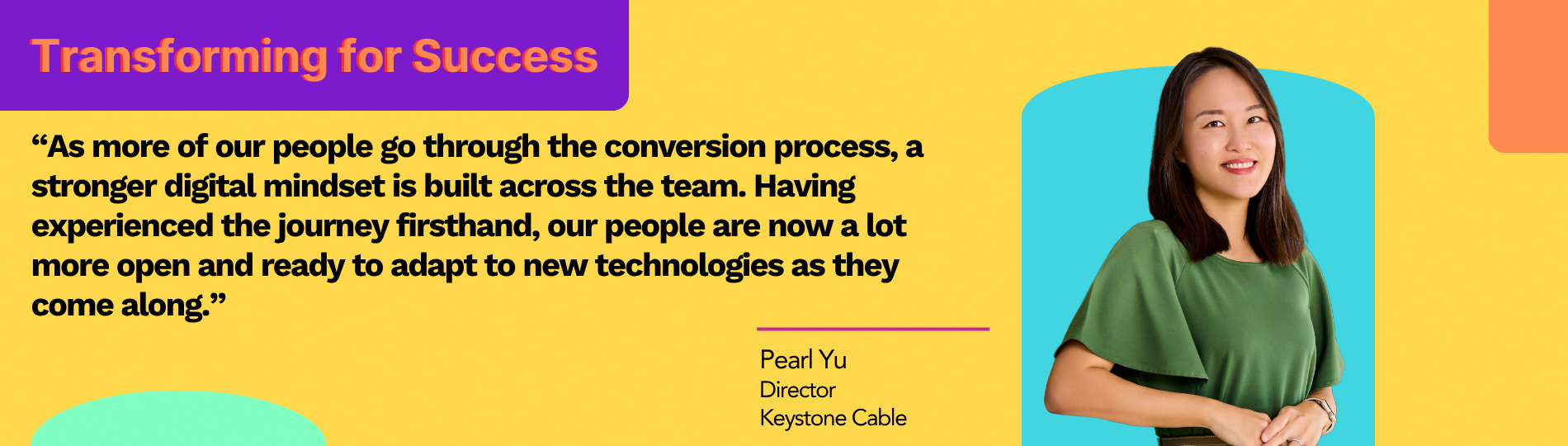
"As more of our people go through the conversion process, a stronger digital mindset is built across the team. Having experienced the journey firsthand, our people are now a lot more open and ready to adapt to new technologies as they come along," says Ms Yu.
Looking Ahead
Keystone Cable's experience offers a practical blueprint for SMEs facing talent shortages and digital transformation pressures. By hiring for potential rather than credentials, investing in structured reskilling programmes, adopting new technologies, and leveraging government support, SMEs can build the capabilities they need, even with a lean headcount. “No matter the outcome, we will certainly learn something,” says Ms Chong, whose journey from piano teacher to production executive demonstrates that career transitions can create lasting value when employers invest in potential and empower people with the skills to succeed.
Keystone Cable's experience offers a practical blueprint for SMEs facing talent shortages and digital transformation pressures. By hiring for potential rather than credentials, investing in structured reskilling programmes, adopting new technologies, and leveraging government support, SMEs can build the capabilities they need, even with a lean headcount. “No matter the outcome, we will certainly learn something,” says Ms Chong, whose journey from piano teacher to production executive demonstrates that career transitions can create lasting value when employers invest in potential and empower people with the skills to succeed.